
Technical Insight
Carbon Conductive Networks in Lead-Acid Batteries: Charge Acceptance, PSOC, and Water-Loss Tradeoffs
Method-conditioned guide to acetylene black, conductive carbon black, graphene-family, and CNT-family networks in lead-acid negative plates, covering conductivity, charge acceptance, PSOC, pores, sulfation, gas evolution, water loss, self-discharge, dispersion, and validation.
Author: Aurexene Materials Engineering Team · Last updated: 2026-08-28
Quick Answer
Choose carbon by network morphology and total battery burden. Particulate carbon is the robust baseline; CNTs can create long-range paths at lower loading; GNP creates a platelet network. A route advances only when resistance and charge-acceptance gains survive paste, pores, gas, water-loss, self-discharge, and cycle testing.
Problem
A conductive network can reduce negative-plate resistance and support high-rate discharge, recharge, and PSOC operation. The same high surface area, impurities, or altered pore structure can increase hydrogen evolution, water loss, self-discharge, paste viscosity, or dry-out—especially in sealed batteries.
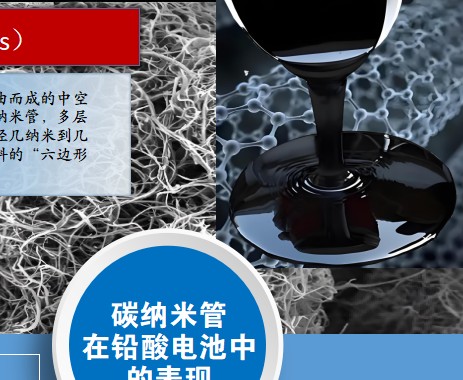
Mechanism
| Network | Contact mechanism | Main process burden |
|---|---|---|
| Acetylene Black / Conductive Carbon Black | Branched particulate aggregates create many local contacts and influence pore/electrolyte retention. | Surface area, oil absorption, viscosity, ash/metals, loading, gas, and self-discharge. |
| MWCNT / FWCNT / SWCNT | High-aspect-ratio tubes form long conductive bridges across lead-particle gaps. | Dispersion, tube damage/length, residual metals, low-dose accuracy, paste network retention, and cost. |
| GNP | Platelets create planar contacts and can reinforce a sheet-like network. | Flake agglomeration/orientation, pore blocking, dispersion, loading, and generic-graphene-to-grade evidence gap. |
Tradeoff
Conductivity and charge acceptance must be read beside hydrogen evolution, water loss, pressure, self-discharge, paste rheology, pore distribution, active-material cohesion, and cycle retention. A lower additive loading is not automatically a lower formulation burden.
Material Strategy
- Build a particulate-carbon baseline with Acetylene Black or Conductive Carbon Black.
- Move to one CNT grade only if a low-loading or PSOC gap remains; record tube dimensions, metals, surface, dispersion, and retained network.
- Evaluate GNP as a platelet architecture, not as proof of every generic graphene claim.
- Keep BaSO4 and organic expander grades constant so carbon effects are not confounded.
Recommended Architectures
| Route | Use when | First validation gate |
|---|---|---|
| Particulate carbon baseline | Robust processing and familiar qualification matter more than minimum loading. | Paste, resistance, pores, gas, water loss, self-discharge, and cycling. |
| High-aspect-ratio CNT | A lower-loading long-range network may justify tighter dispersion and cost control. | Grade identity, tube integrity, metals, DCA/PSOC, gas, water loss, and retention. |
| Platelet GNP | Planar contacts or platelet reinforcement are intentionally studied. | Flake distribution/orientation, pores, resistance, gas, water loss, and cycling. |
Measurement and Validation
- Characterize carbon morphology, distribution, surface area/structure, metals/ash, moisture, surface chemistry, dispersion, and lot consistency.
- Measure paste rheology, density, pores, network distribution, formation, plate resistance, DCA, high-rate/low-temperature response, and PSOC behavior.
- Measure hydrogen evolution, water loss, pressure, self-discharge, corrosion, thermal response, storage, and cycle retention in the target FLA/VRLA/AGM/GEL/deep-cycle/SLI battery.
Related Products
Related Applications
Downloads
Lead-Acid Battery Materials Brochure · Request method-matched carbon evidence
Need to apply this boundary to a grade, formulation, test method, or production route? Discuss it with the Aurexene Materials Engineering Team.