
What is Eco Black?
Eco Black
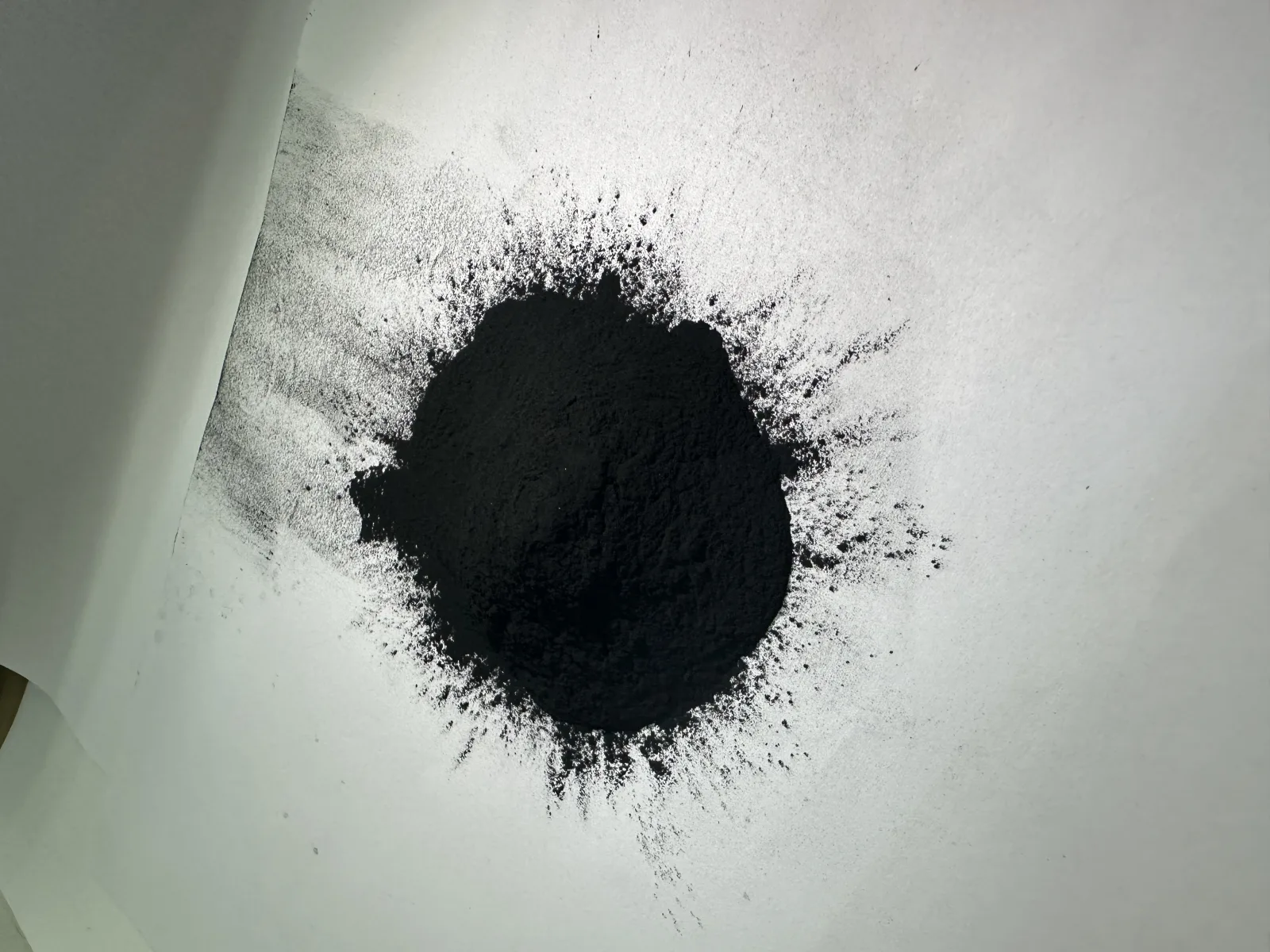
Eco Black is a Cu-Mn-Fe black pigment system for white or light visual laser marking on opaque black polymer and for optical-black formulations.
Technical owner: Aurexene Materials Engineering Team · Last updated: 2026-08-30
What It Is Not
- Eco Black is not recycled carbon black.
When Not to Use It
- Do not use Eco Black when the host must remain transparent or light-colored, or when recycled-carbon content is the purchasing requirement.
- Do not represent Eco Black as food-contact compliant from the available SGS EN 71-3 toy-material report. That report is not a food-contact authorization or final-article migration test and records soluble manganese and copper above its stated limits.
Intrinsic Screening Summary
- Identity screen
- Copper-manganese-iron black system; Composite black powder
- Material-level integration
- Fix the Eco Black grade, polymer, base color, additive loading, compounding route, specimen thickness, laser wavelength, optics, focus, power, speed, and pulse condition before comparing mark response. For the current grade, supplied form, sample, and commercial availability, request confirmation. Treat the owned 355 nm nylon coupon and video as matched application-test evidence only; reject transfer to another polymer, wavelength, formulation, or production window without new validation.
Application Fit
Selection & Validation Framework
| Decision Question | Material-Level Answer |
|---|---|
| Integration and processing criteria | Required for: Optical Black Coatings and Laser Marking Pigments. Measure: visible transmission; haze; color coordinates; NIR transmission; particle distribution; settling; redispersion; adhesion; film continuity; aging durability; storage stability; moisture exposure. Sample state: final coating thickness. Failure signals: Use when evaluating Optical Black Coatings / Laser Marking Pigments formulations or systems.. |
Material Identity & Specification Status
Approved values for CAS / identity, Particle size, Density, Purity, and Packaging are not published; confirm them during quotation or sample review.
| Property | Value |
|---|---|
| Composition | Copper-manganese-iron black system |
| Morphology | Composite black powder |
| Storage | Dry sealed container |
Material Evidence
Technical Guides
| Technical Guide | Summary |
|---|---|
| Absorption, Scattering, Surface Roughness, and Gloss in Low-Reflectance Coatings | Absorption, Scattering, Surface Roughness, and Gloss in Low-Reflectance Coatings — a method-conditioned engineering guide for Optical Black Coatings covering structure-function behavior at the material, interface, and finished-system boundary, process limits, validation, and qualification boundaries. |
| Adhesion Loss, Abrasion, Chemical Attack, and Outdoor Weathering | Adhesion Loss, Abrasion, Chemical Attack, and Outdoor Weathering — a method-conditioned engineering guide for Optical Black Coatings covering structure-function behavior at the material, interface, and finished-system boundary, process limits, validation, and qualification boundaries. |
| Agglomeration, Rub-Up, Float, Flood, Streaking, and Gloss Variation | Agglomeration, Rub-Up, Float, Flood, Streaking, and Gloss Variation — a method-conditioned engineering guide for Optical Black Coatings covering structure-function behavior at the material, interface, and finished-system boundary, process limits, validation, and qualification boundaries. |
| Applying Optical-Black Coatings to Metal, Glass, Polymer, Ceramic, and Porous Substrates | Applying Optical-Black Coatings to Metal, Glass, Polymer, Ceramic, and Porous Substrates — a method-conditioned engineering guide for Optical Black Coatings covering structure-function behavior at the material, interface, and finished-system boundary, process limits, validation, and qualification boundaries. |
| Color, Gloss, Texture, Thickness, Adhesion, and Durability Test Boundaries | Color, Gloss, Texture, Thickness, Adhesion, and Durability Test Boundaries — a method-conditioned engineering guide for Optical Black Coatings covering structure-function behavior at the material, interface, and finished-system boundary, process limits, validation, and qualification boundaries. |
Commercial Availability
Supplier role: Request confirmation
Supply status: Request confirmation
Sample status: Sample availability requires confirmation
Commercial details are not published until the source and verification fields are complete and the Supplier Data Packet is signed by the sales owner, technical reviewer, and resource/compliance owner. Request current grade, form, sample, packaging, and delivery confirmation.
Documents & Inquiry
Document access follows the current approval state. Unapproved or unavailable files route to a document request instead of a public download.
Technical Data Sheet
Request required
Safety Data Sheet
Request required
Related resources
Grade, Sample & Qualification Support
The Aurexene Materials Engineering Team can review the required form, host system, formulation or process, target, sample quantity, volume and timeline, and the grade-specific evidence needed before qualification.
Review Lab Capabilities for sample evaluation and qualification support, or Production Capabilities for scale-up, quality, documentation, and supply support.
Request Eco Black Sample / Qualification Review