
Technical Insight
Wetting and Dispersing Conductive Additives in Aqueous and Solvent-Based Slurries
Panduan rekayasa ini membahas Wetting and Dispersing Conductive Additives in Aqueous and Solvent-Based Slurries, termasuk batas proses, bukti validasi, dan kebutuhan kualifikasinya.
Author: Aurexene Materials Engineering Team · Last updated: 2026-08-28
Jawaban singkat
Treat wetting, deagglomeration and stabilization as separate gates. Choose aqueous or solvent-based processing from the actual additive, active material, binder, liquid, pH, ions, moisture, residue, collector, drying, safety and electrochemical boundary. Use staged incorporation and controlled energy, then verify bundle or aggregate state, damage, rheology, top-to-bottom hold stability, filtration, coating, dry carbon and binder distribution, processed-electrode function and cell compatibility. Powder disappearance, one size result, microscopy image, viscosity, or zeta potential cannot prove the complete route.
Problem
A powder can look incorporated while dry pockets, trapped air, CNT bundles, platelet stacks or carbon-rich gradients remain. A stable mixing-vessel sample can also fail during hold, dilution, filtration, coating or drying.
Aqueous and solvent routes are not interchangeable. Binder association, pH, ions, water content, active-material and collector compatibility, evaporation, residue, safety and electrochemical limits must be reviewed for the intended chemistry.
Mekanisme
Wetting displaces gas from carbon surfaces. Deagglomeration applies enough stress to open unwanted structures without unacceptable tube shortening, platelet fracture, aggregate change, heating or contamination. Stabilization maintains the usable distribution during later low-shear and high-solids stages.
Steric, electrostatic and associative mechanisms depend on the complete formulation. Zeta potential can inform selected aqueous boundaries but does not establish nonaqueous stability, dry distribution or electrode performance. Drying can redistribute carbon and binder even when the wet slurry is stable.
Tradeoff
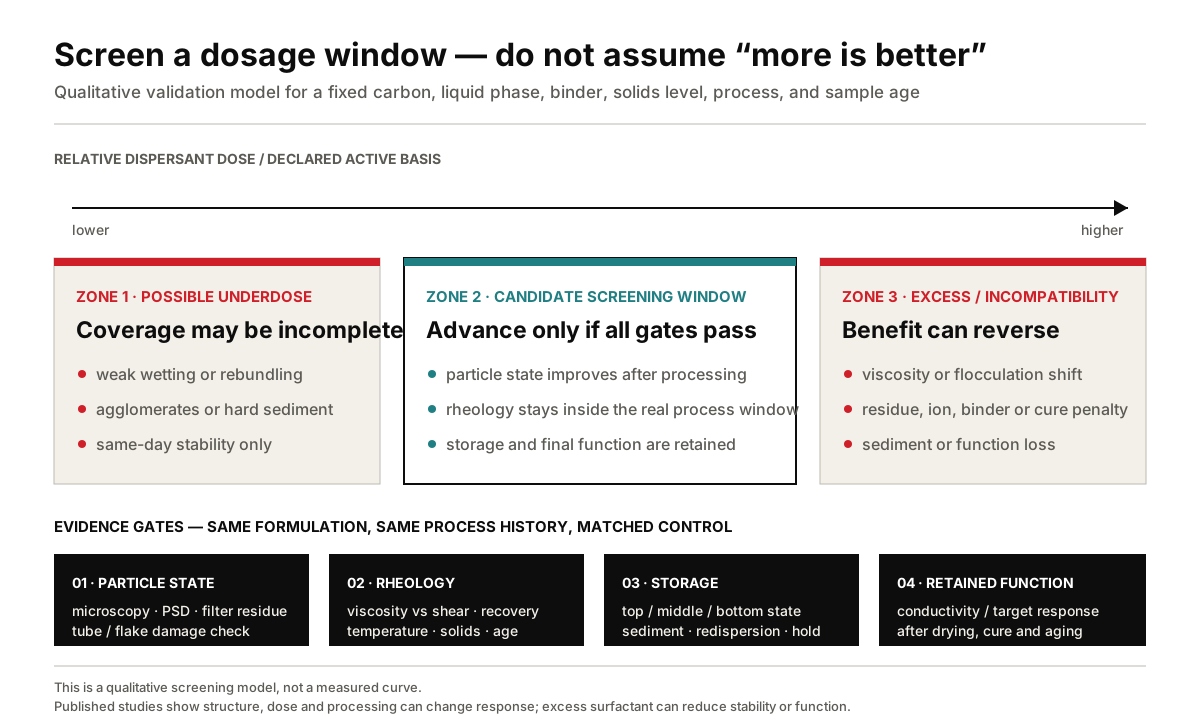
More energy can improve deagglomeration while damaging high-aspect-ratio or platelet structures, heating the slurry and entraining gas. More dispersant can improve wet stability while adding residue, ions, binder competition or electrochemical risk.
Higher solids improves production and drying economics but amplifies wetting, torque and rheology limits. A supplied dispersion can reduce powder handling yet fixes solvent, solids, additives, storage and dilution conditions.
Material Strategy
Screen Conductive Carbon Black, Multi-Walled Carbon Nanotubes (MWCNT), Single-Walled Carbon Nanotubes (SWCNT), Few-Walled Carbon Nanotubes (FWCNT), GNP, and CNT x GNP (CNTxGNP) with morphology-appropriate complementary methods and damage controls.
Evaluate the Gemini Dispersant System only with a declared dose and dry carryover after binder, solvent, active-material, ionic, moisture, residue and electrochemical compatibility are established. Include dispersant-free and supplied-form controls.
Recommended Architectures
| Gate | Question | Reject shortcut | Evidence |
|---|---|---|---|
| Wetting | Has liquid displaced gas and penetrated the supplied carbon state? | Powder disappearance means complete wetting | Feed-time, dry-pocket, floating-solid, torque, power, temperature, foam and entrained-air history |
| Deagglomeration | Are unwanted aggregates, bundles or stacks opened without unacceptable damage? | One particle-size or microscopy result ranks every morphology | Complementary distribution, retained tube or platelet state, energy history, sampling and uncertainty |
| Stabilization and electrode transfer | Does the state survive hold, dilution, filtration, coating and drying without incompatible residue? | Zeta potential or viscosity proves electrode stability | Spatial hold samples, fixed-history rheology, filtration, defects, dry gradients, residue and electrochemical controls |
Measurement & Validation
- Freeze active material, collector, binder, liquid, electrolyte, additive, dispersant, supplied forms, all loadings, target solids, pH, ion, water, residue, safety and electrochemical limits.
- Register charge order, feed rate, wetting, mixer and vessel geometry, fill, energy, time, temperature, cooling, torque, power, foam and air. Sample before and after energy input.
- Use complementary aggregate, bundle, tube or platelet methods with sampling, damage, preparation, resolution and detectability controls; no one size method covers all morphologies.
- Measure fixed-history rheology, recovery, hold and dilution response, top-middle-bottom state, filtration and coating defects under evaporation-controlled conditions.
- Map dry carbon, binder and pore gradients; measure adhesion and electrical function; then confirm residue, moisture, ions, wetting and chemistry-specific cell response with production lots, controls, repeats and uncertainty.
Qualification Boundary
Freeze grades, lots and supplied forms; active material, collector, binder, solvent, electrolyte and dispersant; wet and dry composition; pH, ions, water and residue; charge order and feed; mixer, vessel, energy, time and temperature; gas and foam control; distribution and damage methods; sample age and rheology; hold, dilution, filtration and coating; drying and gradients; calendered state; electrical, mechanical and electrochemical methods; safety boundary; production equipment; controls; repeats; uncertainty; and acceptance criteria.
Do not publish an aqueous, solvent or dispersant recommendation from powder disappearance, one particle-size result, microscopy, viscosity or zeta potential alone.
Produk terkait
Aplikasi terkait
Related Comparisons
Downloads & Engineering Support
Both resources remain approval-required and cannot establish aqueous or solvent compatibility, dispersion, dispersant dose, slurry stability, dry-electrode distribution, electrochemical performance, safety, or production capability.
- Request a slurry dispersion process study
- Discuss wetting, dispersion and electrode compatibility
- Discuss high-solids mixing and coating scale-up
What to Validate
The slurry-process framework is engineering guidance. No Aurexene Materials grade or dispersant system is assigned an aqueous or solvent route, dosage, dispersion, stability, coating, electrode, electrochemical, cycling, safety or production result until verified grade-, lot-, formulation-, liquid-, electrode-, process-, equipment-, residue-, electrochemical-, statistical-, control-, method-, and application-specific evidence is available.
Perlu menerapkan batas ini pada mutu, formulasi, metode uji, atau jalur produksi? Bahas bersama Tim Rekayasa Aurexene Materials.