
Application
Laser Marking Pigments & Additives for Plastics
Laser marking uses a laser to create a permanent visible mark on a polymer surface through controlled color change, carbonization, foaming, ablation, or scattering. This application covers visual-mark contrast, substrate damage, process window, and durability; it does not cover LDS/MID circuit activation.
Quick Answer
Laser marking pigments and additives help plastics form readable light or dark marks through controlled color change, carbonization, foaming, ablation, scattering, or pigment transformation. Start with the required result: light on black or dark, dark on white or light, or controlled contrast on a colored substrate. Achievable tone depends on resin, color package, additives, wavelength, and settings. Qualify the finished formulation under the intended 1064 nm or 355 nm laser; wavelength response does not transfer between formulations.
How Can Aurexene Materials Support Laser Marking?
Aurexene Materials supports screening and qualification of inorganic pigment and additive candidate routes for laser marking of plastics. Candidate routes currently listed include Eco Black, Black Titania, Cu-Doped Tin Oxide, BCHP, ATO and selected bismuth-oxide systems. Current grade, form, sample, and commercial availability require confirmation. Material selection depends on the polymer, base color, target mark color, laser wavelength, loading, processing conditions, and regulatory requirements; these links identify candidate routes, not universal compatibility or performance claims.
What Are Laser Marking Pigments & Additives for Plastics?
Laser marking creates a permanent visible mark while balancing contrast, polymer compatibility, color and haze limits, thermal damage margin, production laser window, and post-mark durability.
Choose the Buying Route Before the Material
Wide table — scroll horizontally to compare material, laminate, equipment, and service intents.
| User intent | Aurexene Materials can support | Outside this offer |
|---|---|---|
| Make a light mark on an existing single-layer black plastic | Screen pigment or additive candidates against the exact polymer, color package, geometry, laser, and acceptance method. | A guaranteed result from an unspecified black plastic or a result transferred from an unmatched coupon. |
| Source a laser-marking additive, pigment, or masterbatch route | Provide pigment or additive selection and formulation or qualification support. Current grade, supplied form, sample, and commercial availability require confirmation. | Automatic confirmation that a ready-made masterbatch exists for every polymer, color, or laser system. |
| Use a two-layer laminate, coating, or removable surface layer | Help screen the functional pigment or coating-material route and define a method-matched validation plan. | Supply of a finished laminate, label, or converted multilayer part unless separately confirmed. |
| Buy a laser machine or outsource contract marking | Provide material-side qualification inputs for the selected equipment or processing partner. | Laser equipment sales, machine integration, or contract marking services. |
Mechanism
Additives may function through photothermal conversion, laser-induced pigment transformation, carbonization promotion, foaming control, or scattering modification within the host system.
The mechanism depends on the following system interfaces:
- host polymer or binder compatibility
- laser wavelength, focus, pulse, speed, and energy window
- additive dispersion, masterbatch, or letdown route
- thermal exposure and substrate damage zone
- post-process adhesion, cleaning, abrasion, or weathering interface
Choose the Mark Direction Before the Additive
Pigment color is not the same as mark color. Compare light-on-dark, dark-on-light, colored-substrate, and transparent-host routes on the exact polymer-color-additive-laser combination.
| Scenario | Materials | Evidence level | Guidance |
|---|---|---|---|
| LDS/MID catalytic activation | Use the separate LDS/MID application | LDS/MID is a different laser-activated metallization process. | Do not apply visual laser-marking selection to LDS/MID activation; route this decision to the dedicated LDS/MID application. |
| Antimony-free laser marking | Cu-Doped Tin Oxide / Eco Black / Black Titania / Ca-Doped Bismuth Oxide / Bismuth Oxide | Cu-Doped Tin Oxide is a good laser-marking pigment option for non-antimony scenarios; require grade-specific composition and method-matched laser evidence. | When the customer specification requires antimony-free content, treat it as a first-pass exclusion rule, not a late compliance check. Exclude ATO, Antimony Trioxide (Sb2O3), and any antimony-containing co-additive before ranking the remaining routes by mark color, polymer, wavelength, damage margin, process window, and durability. Require grade-specific supplier composition evidence. |
| Dark photothermal or chemical-color-change marking | Black Titania / Ca-Doped Bismuth Oxide / Bismuth Oxide | Candidate routes; bismuth compatibility evidence must be confirmed. | Screen these as candidate dark-mark routes, not as a universal ranking. Determine whether contrast comes from controlled local heating or a chemical color change, then reject candidates that require burning, excessive loading, or an unacceptably narrow process window. Bismuth oxide and Ca-doped bismuth oxide routes require polymer-compatibility and processing-temperature validation, especially for high-temperature compounding in engineering plastics. |
| Dark mark on a white, natural, or light-colored polymer | Host, color package, and laser-process route first | General mechanism route; final-formulation validation required. | Define whether a black result is mandatory or a readable dark gray result is acceptable. Screen controlled carbonization, photochemical color change, or an additive-assisted route on the exact resin and color package; reject brown or yellow halos, base-color drift, scorching, part damage, and a fragile process window. |
| Controlled contrast on a colored polymer | Colorway-specific pigment/additive formulation screen | General route; each colorway and full formulation must be tested. | Treat yellow, red, blue, green, natural, recycled, and other colorways as separate screens. Compare starting color, resulting mark polarity, code grade, color shift, damage, and repeatability across the actual pigment, filler, stabilizer, flame-retardant, and recycled-content package; do not transfer a result from another color formulation. |
| Light marking through foaming, ablation, or scattering | Host and laser-process route first | Mechanism-led route; validate on the final polymer and geometry. | Establish whether controlled foaming, surface ablation, or a scattering change can create the required light mark before adding an absorber. Prove mark morphology, affected depth, part integrity, process window, and durability on the final polymer and geometry. |
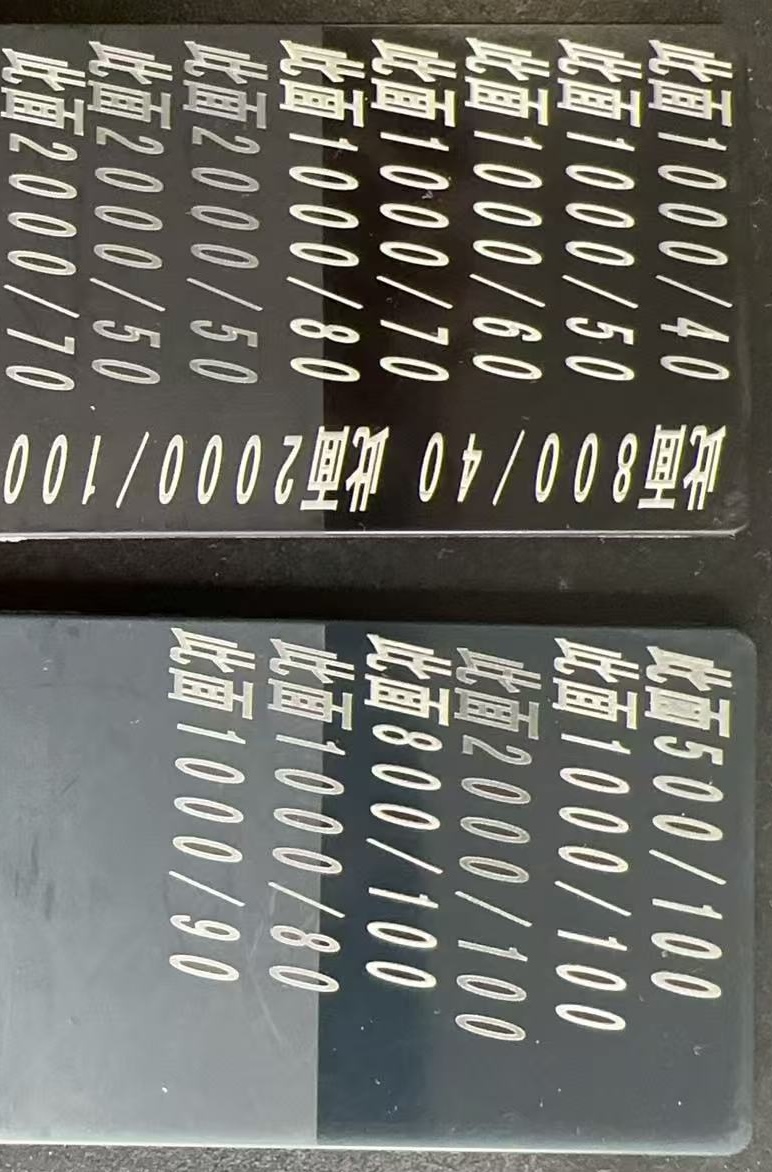
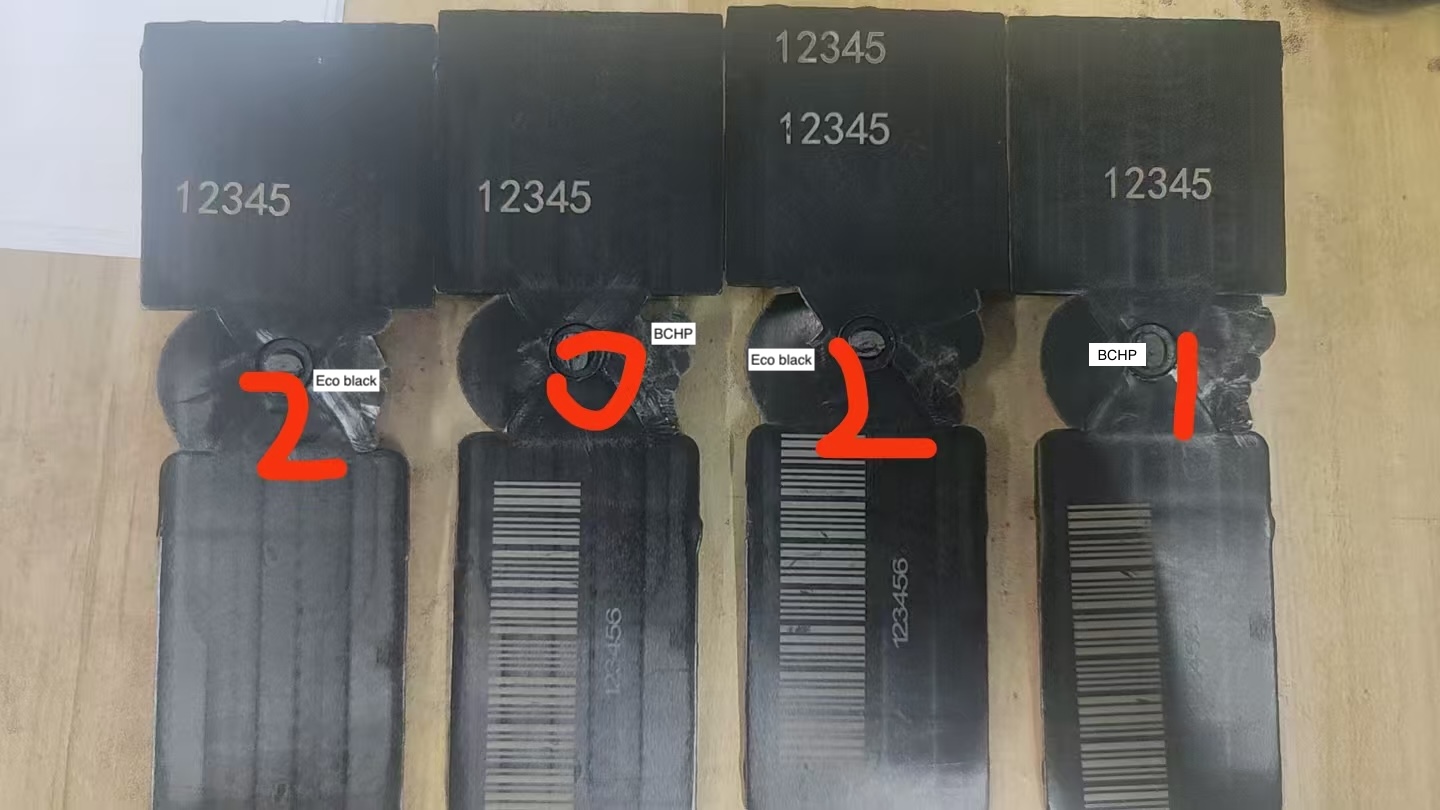
| White or light mark on an opaque black polymer | Eco Black (Cu-Mn-Fe black) | Aurexene Materials-owned 355 nm nylon coupon/video evidence; customer-specific validation required. | Screen Eco Black as a Cu-Mn-Fe black pigment candidate for this visual laser-marking route. Owned 355 nm nylon footage establishes an application-test route requiring confirmation of the nylon grade, Eco Black loading, laser settings, white-mark contrast, surface morphology, damage boundary, and durability before a public performance claim. |
| Low-visible-color absorber screening for light or transparent hosts | ATO | ATO has public laser-additive precedent but contains antimony. | Use this as a constrained screen when dark absorbers break base color, haze, or transparency limits. Prove spectral coupling, unmarked-part appearance, readable contrast, loading, thermal damage margin, and durability; low visible color does not guarantee laser response. |
Industries Using Laser Marking Additives
Laser marking additives are commonly screened where molded plastic parts need durable identification, branding, compliance marks, or machine-readable traceability.
- Automotive and mobility parts for durable serial numbers, QR codes, switchgear, connectors, and under-hood identification
- Electronics and electrical components for housings, connectors, cable markers, traceability codes, and machine-readable labels
- Medical devices and laboratory products that need permanent, abrasion-resistant identification without inks or labels
- Consumer electronics and appliances for logos, control legends, compliance marks, and part traceability
- Packaging and logistics components for batch codes, barcodes, QR codes, and reusable-container identification
- Industrial equipment, tools, and safety components for durable part numbers, operating marks, and lifecycle traceability
- Livestock identification and ear tags for human-readable marks and optional machine-readable codes; qualify outdoor, abrasion, chemical, color-contrast, tag-mechanics, and EID compatibility requirements on the finished tag for the target market
Laser Marking Additive Selection Checklist
- Define the required result: light on black or dark, dark on white or light, or controlled contrast on every colored substrate. Record whether exact white or black is mandatory, or whether a readable light or dark tone is acceptable, together with the text, barcode, QR, Data Matrix, logo, or serial-number target.
- Identify the exact polymer family and grade—Acrylonitrile Butadiene Styrene (ABS), Polycarbonate (PC), Polyamide (PA6 or PA66), Polypropylene (PP), Polyethylene (PE), or another resin—plus fillers, recycled content, base color, thickness, and surface finish.
- Match the additive route to the intended 1064 nm fiber, 355 nm UV, 532 nm green, or CO2 laser and record power, speed, focus, pulse condition, and target cycle time.
- Apply appearance and compliance gates before ranking: antimony-free status, unmarked-part color, haze, transparency, gloss, additive loading ceiling, carrier or masterbatch composition, and required TDS/SDS evidence.
- Compare candidates at matched conditions for contrast, intended-reader barcode, QR, or Data Matrix performance, surface morphology, thermal-damage margin, adjacent-setting process window, dispersion, and lot repeatability.
- Confirm abrasion, cleaning, chemical, weathering, and thermal-aging durability on the finished part before approving the formulation for production.
Application Evidence
Scope Boundary
- Laser marking is not LDS/MID activation or laser welding; its primary output is a controlled visible or machine-readable mark.
- Do not use visual laser-marking guidance for LDS/MID metallization or laser transmission welding; visible contrast, catalytic activation, and weld formation are different functions.
Target Performance Bands
Compare mark contrast and damage under the same polymer, pigment grade, loading, wavelength, fluence, speed, focus, geometry, and aging conditions.
| Metric | Target range | Unit | Condition | Required |
|---|---|---|---|---|
| Laser response threshold | Report contrast or activation at the selected wavelength and lowest practical additive loading. | nm; W or % power; mm/s; kHz or pulse width; grayscale; ΔL*; contrast ratio; barcode grade; additive wt% | Final polymer, color, thickness, optics, focus, speed, power, pulse condition, and surface finish. | yes |
| Thermal damage boundary | Functional mark response without unacceptable burning, blistering, deformation, adhesion loss, gloss shift, or embrittlement. | pass/fail; ΔE; gloss units; roughness; dimensional change %; mechanical retention % | Upper approved energy setting on final part geometry and after relevant exposure. | yes |
| Process window width | Multiple adjacent settings or a defined production recipe pass contrast, appearance, damage, and cycle-time limits. | setting count; power range; speed range; focus range; cycle time; additive wt% | Speed, focus, power, pulse condition, additive loading, and lot condition. | yes |
| Appearance compatibility | Required for light-color or transparent hosts; mark is readable without unacceptable color, haze, opacity, or gloss shift. | ΔE; haze %; VLT %; opacity; contrast ratio; gloss units | Final base color, part thickness, additive loading, and customer viewing method. | conditional |
Failure Modes
Use failure rows to identify a measurable trigger and the corresponding design response.
| Failure type | Root cause | Manifestation | Mitigation strategy |
|---|---|---|---|
| Low Contrast | Candidate material was selected without matching polymer, color, wavelength, energy density, and additive loading. | Low ΔL*, weak contrast ratio, unreadable barcode/QR code, or mark disappearing after viewing-angle or durability checks. | Measure contrast against wavelength, speed, power, focus, additive loading, and host color before selecting the route. |
| Burning or Polymer Damage | Thermal damage extends beyond the intended marking mechanism, rather than remaining a controlled photothermal or chemical response. | Burn-through, blistering, warpage, gloss change, roughness, odor/charring, adhesion loss, or embrittlement. | Define the thermal damage boundary and reject routes that exceed the intended marking mechanism or damage the part. |
| Inconsistent Mark | The process window was validated at one condition but not across production material and setting variation. | Speckled mark, mottled contrast, unreadable codes on some parts, or drift between batches. | Validate dispersion, mark uniformity, lot repeatability, and accepted setting range across the production laser window. |
| Appearance or Haze Failure | Contrast was prioritized without measuring base color, haze, VLT, opacity, or gloss. | Darkened base part, haze increase, visible speckle, gloss shift, or color mismatch before marking. | Use ATO only when light-color constraints dominate and reject dark absorber routes that cannot meet appearance targets. |
| Colorway or Formulation Transfer Failure | Polymer and additive absorption, starting color, dispersion, and thermal response changed even though the laser recipe remained the same. | Mark polarity, tone, contrast, halo, damage, or process-window width changes between colorways, formulations, cavities, or lots. | Treat every materially different resin and color package as a separate formulation screen and retain a matched production control. |
| Human-Readable Mark but Machine-Readable Code Failure | The route was accepted by eye without defining the code type, reader, lighting, distance, geometry, and grading method. | Text remains legible but a barcode, QR code, or Data Matrix fails to decode consistently or receives an unacceptable grade. | Verify the finished part with the intended reader and declared code-quality method across the accepted process window and service exposures. |
| Durability or End-Use Qualification Failure | Selection stopped at the fresh coupon and did not reproduce the actual service environment, tag mechanics, or reader requirement. | Contrast loss, fading, surface wear, cracking, deformation, code-read failure, or—for EID assemblies—a separate electronic or mechanical failure after exposure. | Define end-use exposures before screening, then remeasure visual and machine readability, color change, part integrity, and any EID function after the applicable aging sequence. |
Validation Data Requested
| Measurement requested |
|---|
| Report laser wavelength in nm, power or % power, scan speed in mm/s, focus offset, pulse frequency or pulse width, spot size when available, additive wt%, polymer grade, part thickness, and surface color for every marked coupon. |
| Measure mark contrast as ΔL*, ΔE, contrast ratio, grayscale value, barcode/QR grade, or reflectance at the accepted production setting and at least one higher-energy damage-boundary setting. |
| Record thermal-damage limits with pass/fail plus measured gloss units, surface roughness, dimensional drift %, adhesion rating, tensile/impact retention %, or visible burn/blister/warpage evidence after upper-window laser exposure. |
| Validate dispersion and processing with particle/agglomerate microscopy, masterbatch or letdown route, viscosity in Pa·s or cP, molding or coating temperature, accepted power/speed/focus range, and lot-repeatability evidence. |
| For durability, compare contrast and adhesion before/after the customer abrasion, cleaning, chemical, weathering, or thermal-aging protocol. |
Technical Basis & References
The pictured marks are application-test evidence only. BCHP visual-mark contrast must be evaluated separately from LDS/MID catalytic activation and subsequent electroless plating. Bismuth oxide and Ca-doped bismuth oxide routes require polymer-compatibility and processing-temperature validation, especially for high-temperature compounding in engineering plastics. Patent evidence supports route and mechanism context only; it is not independent proof of an Aurexene Materials grade claim.
- Fabricating Metallic Circuit Patterns on Polymer Substrates through Laser and Selective Metallization Scientific Reports · 2016
Supports only the boundary between BCHP-related laser activation for LDS/MID and subsequent selective metallization. It does not show that the pictured BCHP visual mark proves catalytic activation, electroless plating performance, or an untested Aurexene Materials grade claim.
- Laser-marking additive DSM IP Assets B.V. / US9150702B2 · 2015
Supports generic bismuth-additive route context covering polymers, processing temperature, masterbatch use, and laser wavelength. Patent evidence is route and mechanism support only and does not independently prove performance, compatibility, or wavelength response for an untested Aurexene Materials grade.
- Laser marking plastic TRUMPF · Accessed 2026-08-30
Supports general mechanism and mark-direction context for carbonization on light-colored plastics, bright foamed marks on dark plastics, and the need to match polymer, additives, and laser wavelength. It does not prove an Aurexene Materials material route.
- Cesa Laser Marking Additives Product Bulletin Avient Corporation · 2023
Supports the dependence of laser-marking response on the resin, laser type, formulation, and production scale, plus the need for full-scale end-product testing. It does not prove compatibility or performance for an Aurexene Materials grade.
- Laboratory Test for Conventional Plastic Ear Tags ICAR · Section 10, Appendix B5; accessed 2026-08-30
Supports livestock ear-tag qualification context covering visual readability, color contrast, artificial aging, abrasion, chemical and temperature exposure, optional machine readability, and tag mechanical integrity. It does not establish regulatory approval for a material or tag.
FAQ
Can laser marking additives be used in ABS?
Yes, laser-marking additives can be screened in ABS, but response depends on the exact ABS or PC/ABS grade, base color, fillers, flame retardants, recycled content, additive dispersion, and laser wavelength. Approve the route only after contrast, damage margin, process-window, and durability testing on the finished formulation.
Which laser-marking routes are suitable when antimony is prohibited?
When the customer specification requires antimony-free content, exclude ATO, Antimony Trioxide (Sb2O3), and any antimony-containing package first. Cu-Doped Tin Oxide is a good pigment option for this scenario; also screen Eco Black, Black Titania, Ca-Doped Bismuth Oxide, or Bismuth Oxide according to the required mark color, host appearance, wavelength, and validated process window.
What causes poor laser marking contrast or polymer burning?
Poor contrast can result from weak spectral coupling, an incompatible polymer or color package, insufficient or excessive additive loading, poor dispersion, moisture, or unsuitable power, speed, focus, and pulse settings. Burning means the energy input exceeded the stable marking window, so contrast and substrate damage must be qualified together.